How to Hang Curtains in a Bay Window (No Drilling Required)


Bay windows are one of the best features a room can have and one of the hardest to dress. Three or more windows meet at angles, so a single straight rod won't follow the shape.
The fix is simpler than it looks. Here's how to hang curtains in a bay window, with or without a drill.
- Treat each section of a bay as its own window: measure it, fit it and give it its own rod.
- Kwik-Hang no-drill brackets tap into wooden window trim, so you can curtain a bay without drilling into the walls.
- Where two Kwik-Hang rods meet at an angle, center support brackets set about 4 inches from the corner hold the rod ends.
- Panels can't slide around an angle, so plan a separate pair of panels for each section of the bay.
Choose Your Bay Window Curtain Layout
Pick a layout before you buy anything. It decides how many rods, brackets and panels you need.
A Rod on Each Window
Each window gets its own rod and pair of panels. It's the simplest setup and gives you the most control over light, since every window opens on its own. It works best when each window has its own trim with room at the top corners.
Rods That Follow the Bay
Separate rods run along each section and meet at the angles, so the curtains trace the full shape of the bay. Choose this layout when the windows sit close together or share trim at the corners.
One Rod Across the Bay
A single straight rod spans the opening of the bay and turns it into its own nook. It's ideal for a window seat, but it mounts to the wall or ceiling instead of the window trim.
Want to see how each layout looks? Browse these bay window curtain ideas.
How to Measure a Bay Window for Curtains
Bay windows are easier to measure in pieces. Grab a metal tape measure and a notepad, then follow these steps.
- Measure each section separately. Measure the width of each window's trim from outside edge to outside edge. Write each number down, since sections are often different sizes.
- Calculate the fabric width. For standard fullness, plan on panels that add up to 2 times the width of each section. Use 2.5 to 3 times for a fuller look.
- Measure the length. With trim-mounted brackets, measure from the top of the trim to where the curtains should end. That could be the sill, just below it or the floor.
- Match to a standard size. Curtains come in standard lengths of 63, 84, 96, 108 and 120 inches. If you land between sizes, buy the longer one and hem it.
- Check for center supports. Any rod longer than 60 inches needs a center support bracket to keep it from sagging.
For every measurement in detail, see our guide on how to measure for curtains the right way.
How to Hang Curtains in a Bay Window Without Drilling
Kwik-Hang curtain rod brackets tap into the top corners of your window trim instead of the wall. You won't need a drill, level or pencil. There are no holes to patch when you move, either.
Before you start, check your trim. Kwik-Hang brackets need traditional wooden trim between 1/2 inch and 1 inch wide. They're not recommended for hardwoods like oak, or for PVC, MDF, metal trim or crown molding.
You'll need:
- Kwik-Hang curtain rod brackets
- Kwik-Hang center support brackets, if your layout needs them
- A curtain rod for each section of the bay
- A hammer or mallet
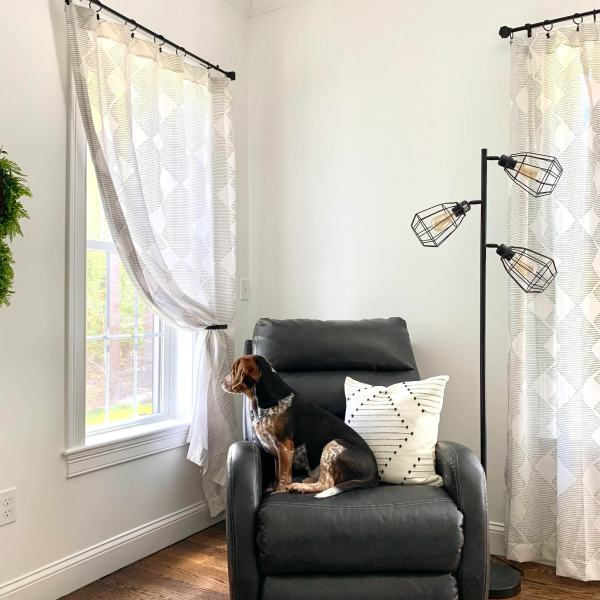
Get No-Drill Curtain Rod Brackets
Tap into wooden window trim in minutes. Each bracket holds up to 20 pounds.
SHOP ON KWIK-HANGMethod 1: A Rod on Each Window
- Place the first bracket. Set a bracket on the top corner of the first window's trim, right where the trim meets the wall.
- Tap it in. Tap the bracket into the trim with a hammer, then repeat on the other top corner.
- Add a center support if needed. If that window is wider than 60 inches, tap a center support bracket into the top of the trim at the middle.
- Hang the rod. Slide the panels onto the rod and set it in the brackets.
- Repeat for each window. Each window in the bay gets its own pair of brackets, rod and panels.
Method 2: Rods That Follow the Bay
This method uses the same setup Kwik-Hang recommends for corner windows, repeated at each angle of the bay.
- Install the outer brackets. Tap a left bracket into the outer top corner of the first window. Then tap a right bracket into the outer top corner of the last window.
- Install center supports at each angle. Tap a center support bracket into the trim about 4 inches from each side of every angle in the bay.
- Add support on long sections. If any section is wider than 60 inches, add a center support at its middle too.
- Prep the rods. Remove the inner finial from each rod so the rod ends can meet at the angles. Keep the finials on the outer ends.
- Hang the curtains. Slide each section's panels onto its rod, then set the rods in the brackets. A curtain rod corner connector can join the ends, but it's optional.
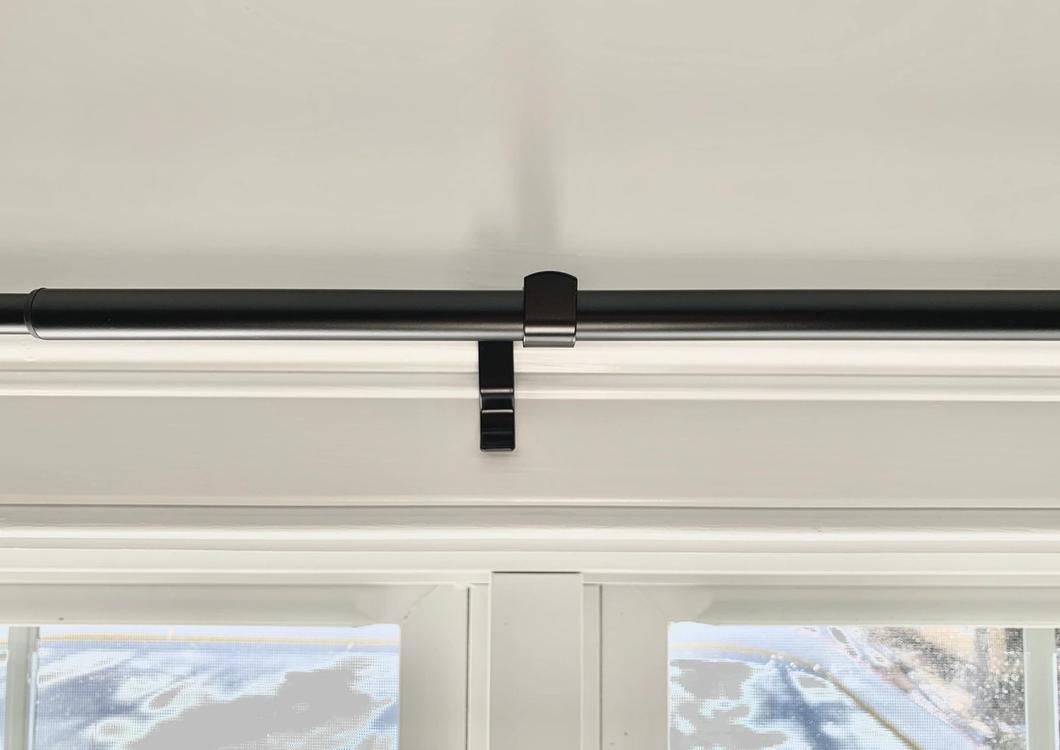
Get No-Drill Center Support Brackets
Hold rod ends at each angle and keep long sections from sagging.
SHOP ON KWIK-HANGLayering sheers behind drapes? Use double curtain rod brackets and the double center support bracket. See more in how to layer curtains like a pro.
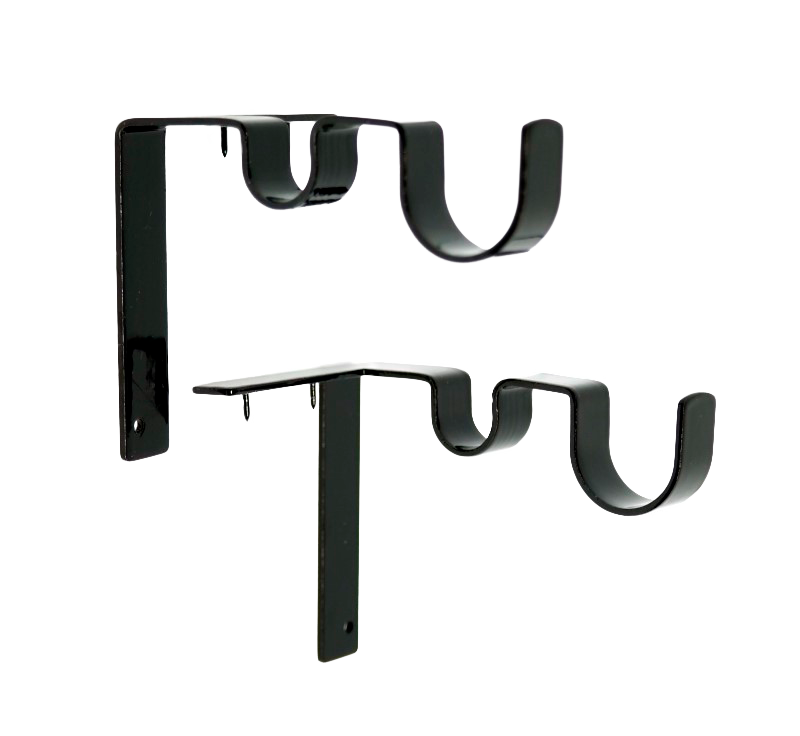
Get No-Drill Double Rod Brackets
Hold a 5/8-inch rod and a 1-inch rod on one bracket, no drilling required.
SHOP ON KWIK-HANGHow to Hang Bay Window Curtains With a Drill
No wooden trim around your bay? A wall-mounted rod is the traditional option. You'll need a drill, screws, wall anchors, a level, a pencil and a rod system made for angles.
- Choose your hardware. Bay window rod kits use adjustable elbow connectors to turn the angles. Flexible curtain tracks bend to fit curved bays.
- Mark the brackets. Plan a bracket near each outer end, one on each side of every angle and one at the middle of any long section. Use a level so the marks line up.
- Install the brackets. Drill pilot holes at each mark, insert wall anchors unless you hit a stud, then screw in the brackets.
- Hang the rod and curtains. Slide the panels onto each section, connect the rod at the angles and set it in the brackets.
Hanging lined drapes or blackout panels? Check the weight first with our guide on how to hang heavy curtains.
Tips to Keep Bay Window Curtains From Bunching
The most common bay window frustration is curtains that won't open fully at the corners. These tips keep every panel moving.
- Give each section its own panels. Curtain rings can't slide past a bracket at the angle, so a panel can't travel around the corner.
- Use rings or clips on heavier fabric. They glide more easily than a rod pocket, which tends to bunch and drag.
- Pick the right rod size. Use 5/8-inch rods for sheer or lighter curtains and 1-inch rods for heavy curtains or drapery.
- Mind the weight at the angles. Kwik-Hang corner brackets hold up to 20 pounds, and each center support holds up to 10 pounds.
- Tie panels back. Holdbacks pull open panels clear of the glass so the bay stays bright. Learn more in our guide to curtain tiebacks.
A Bay Window Is Easier to Dress Than It Looks
The trick to hanging curtains in a bay window is to stop treating it as one window. Measure each section and give each one its own rod and panels. Then support the rods where they meet.
Kwik-Hang is The Original No-Drill Curtain Rod Bracket. The patented brackets tap into your wooden window trim in minutes with no drilling, nails or screws. That makes a bay window doable for renters and homeowners alike. Place. Tap. Hang.
Ready to dress your bay window? Shop no-drill curtain rod brackets and center support brackets and hang every section without damaging your walls.
Frequently Asked Questions
What Is the Best Way to Hang Curtains in a Bay Window?
For most bays, the best way is a separate rod and pair of panels on each window. Every window opens on its own, and panels never have to slide around an angle. For a continuous look, run rods along each section and support them where they meet.
Can You Hang Curtains in a Bay Window Without Drilling?
Yes, if your windows have wooden trim. Kwik-Hang no-drill brackets tap into trim 1/2 inch to 1 inch wide and hold up to 20 pounds. They're not recommended for oak, PVC, MDF, metal trim or crown molding.
How Many Brackets Do You Need for a Bay Window?
With a rod on each window, you need one pair of brackets per window. Add a center support for any window wider than 60 inches. For rods that follow the bay, use one pair of brackets on the outer corners. Then add a center support about 4 inches from each side of every angle.
How Do You Measure a Bay Window for Curtains?
Measure each section on its own, from outside edge to outside edge of the trim. Multiply each width by 2 for standard fullness, then measure from the top of the trim to where you want the curtains to end. Our curtain measuring guide covers every step.
Do You Need a Special Curtain Rod for a Bay Window?
No. Standard straight rods work when each section gets its own rod. Bay window rod kits with angled connectors and flexible tracks are options for wall-mounted setups, but they require drilling.